


Magnifying a sample lets you look closely at its surface or a cross-section. The image only reads accurately, though, when you know which sample it was and under what conditions it was taken.
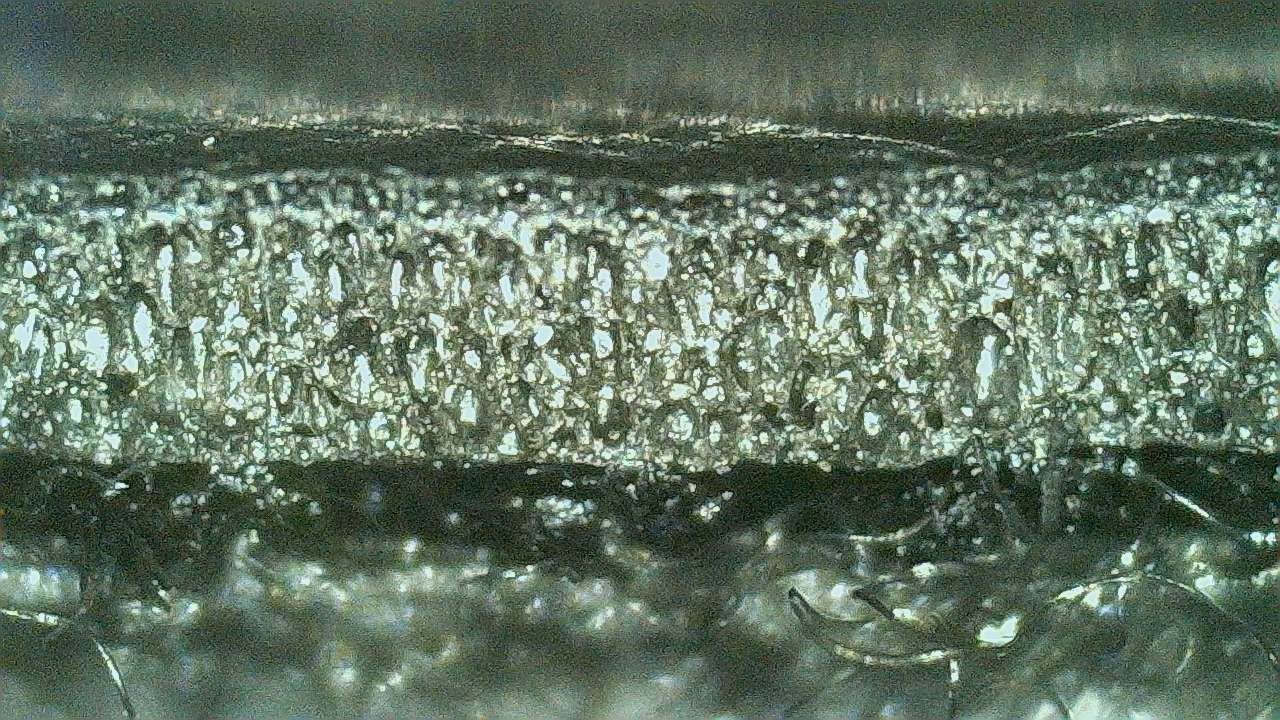
Below is a real microscope image from the REGEN library. The published version carries no magnification or sample data, so the composition or thickness of what you see cannot be judged from it. The image is used here to show what can be observed, and what should be recorded alongside it.
Reading the image from top to bottom
Across the top of the image runs a dark band. Below it, small light and dark areas repeat, and towards the bottom there is a thread-like structure.
Write down what you can see, with where it sits, and set that against the sample record. Observing a shape does not by itself tell you the composition or the name of a layer.
Which sample, and which part of it?
When an image arrives, ask first which sample and which part it shows. Whether it is the face, the back or a cut cross-section has to be known before two images of similar material can be compared.
This published image does not carry enough of that. Deciding whether the dark band is a resin layer or the thread-like structure is the backing needs the sample record.
Magnified is not the same as measured
Something large in an image is not necessarily thick. Measuring needs a scale bar calibrated to real length — a bar inside the image standing for a fixed distance — or the calibrated information of how much real length one pixel covers. If the image was resized before saving, the length per pixel has to be scaled with it.
On the web an image can be displayed at any size, so magnification figures alone do not give real dimensions. Record the scale along with the magnification and shooting conditions.
No measuring reference is provided with this image, so layer thickness is not measured from it, nor compared numerically with another material.
Some questions a photograph cannot answer
Which resin was used, how long it lasts, whether it meets the restricted-substance rules: a single image cannot answer these. They need documents or tests that fit the question.
What an image can do is settle where to look next and what to test. For a failing sample, note where the image was taken, when the change started, and whether there is a reference sample to compare with.
Observation notes to keep with the image
- Sample name and where it was taken
- Which face was photographed: front, back or cross-section
- Magnification, and either a calibrated scale bar or the original length per pixel
- How the sample was prepared and photographed
- The reference sample, and what you are trying to establish
Keep the image and the physical sample together. When another area has to be examined or a test becomes necessary, it is easy to find which sample it was.
Sources
- ZEISS · calibrating an image against real length
Guidance on linking a known real distance to pixel distance in an image.
Written with reference to the sources above. The specification and performance of the material you buy must be confirmed from its own datasheet and test reports.
Enquire with this guide
Tell us the product or the change you have in mind. The title of the guide you are reading is added to your enquiry.
Prepare your enquiry