


Passing a PVC compound between rolls to make a continuous sheet is called calendering. Here two sheets are made: the skin that forms the surface, and the layer that will later be foamed.
The two sheets are combined first, then bonded to the backing fabric. The composite is cooled, reheated to foam, and finally embossed. This route uses no release paper.
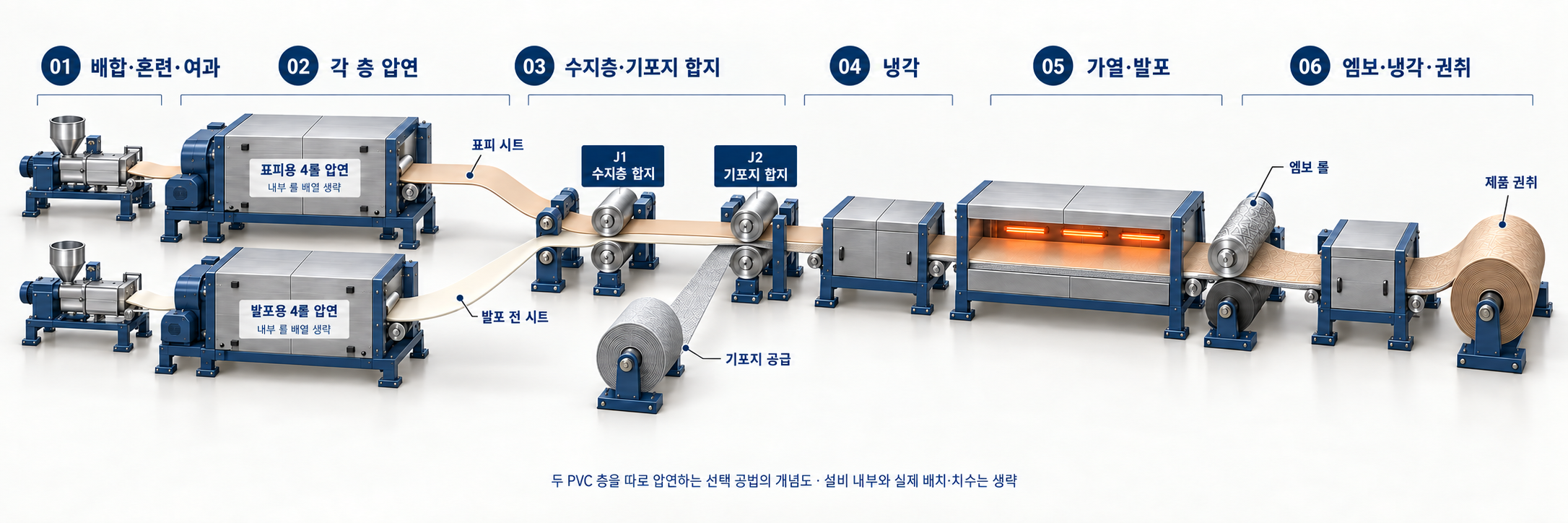
The numbers in the diagram show process order, not real equipment boundaries, distances or dimensions. Roll contact and support structures are simplified or omitted. For the exact material flow, read the route diagram and the step-by-step notes together.
From compounding to foaming and embossing
- Mix the two compounds separately
The skin compound and the foam compound are prepared separately. Each is kneaded to mix the ingredients evenly, then filtered.
- Calender each compound into a sheet
Each compound runs through a four-roll calender. Roll arrangements differ between lines, so the diagram omits the internal set-up.
- Combining the sheets and then the backing
The skin sheet and the unfoamed sheet are combined first, then bonded to the backing fabric. From the top, the stack is skin, pre-foam layer and backing.
- Cool the laminated composite
The composite is cooled before foaming and embossing.
- Reheat to foam
The composite enters the foaming zone, where the pre-foam layer expands into the foam layer.
- Emboss, cool and wind
An embossing roll touches the skin side while a backing roll supports the reverse of the fabric. After embossing the sheet is cooled and wound — the winding step. Additional surface treatment is not part of this route.
The pattern is embossed on the skin after foaming
Figures 05–06 cover heating and foaming, embossing, then cooling and winding. Comparing the layer before and after foaming shows how the material changes. The embossing roll contacts the skin side, and cooling follows embossing.
Casting transfers the pattern from release paper; this route embosses with a roll rather than paper. Depth, feel and gloss cannot be judged from a diagram, so they are approved on a physical sample.
Roll set-up and finishing depend on the route and the specification
- A calender can carry two to five rolls in various arrangements. The four-roll set-up and the order of combining the layers follow the patent example listed under the references.
- Surface treatment and printing are reviewed separately against the product specification. Surface finishing by material covers printing and adjusting feel and gloss.
Calendering is not the finished product
Calendering turns a compound into a sheet between rolls. Casting spreads a liquid paste onto release paper, so the way the material is fed and shaped is different.
The foamed product described here is not finished by calendering alone. After lamination come cooling, foaming, embossing and cooling again.
Check the grain code and the physical specification
Choose the embossed pattern from the photographs, then compare depth, feel and gloss on the real sample. Even with the same pattern, material and processing have to be checked together.
REGEN emboss samples are listed so you can pick a code and see whether it suits the product. Availability and the specification it can be applied to must be confirmed separately.
Material flow and process order
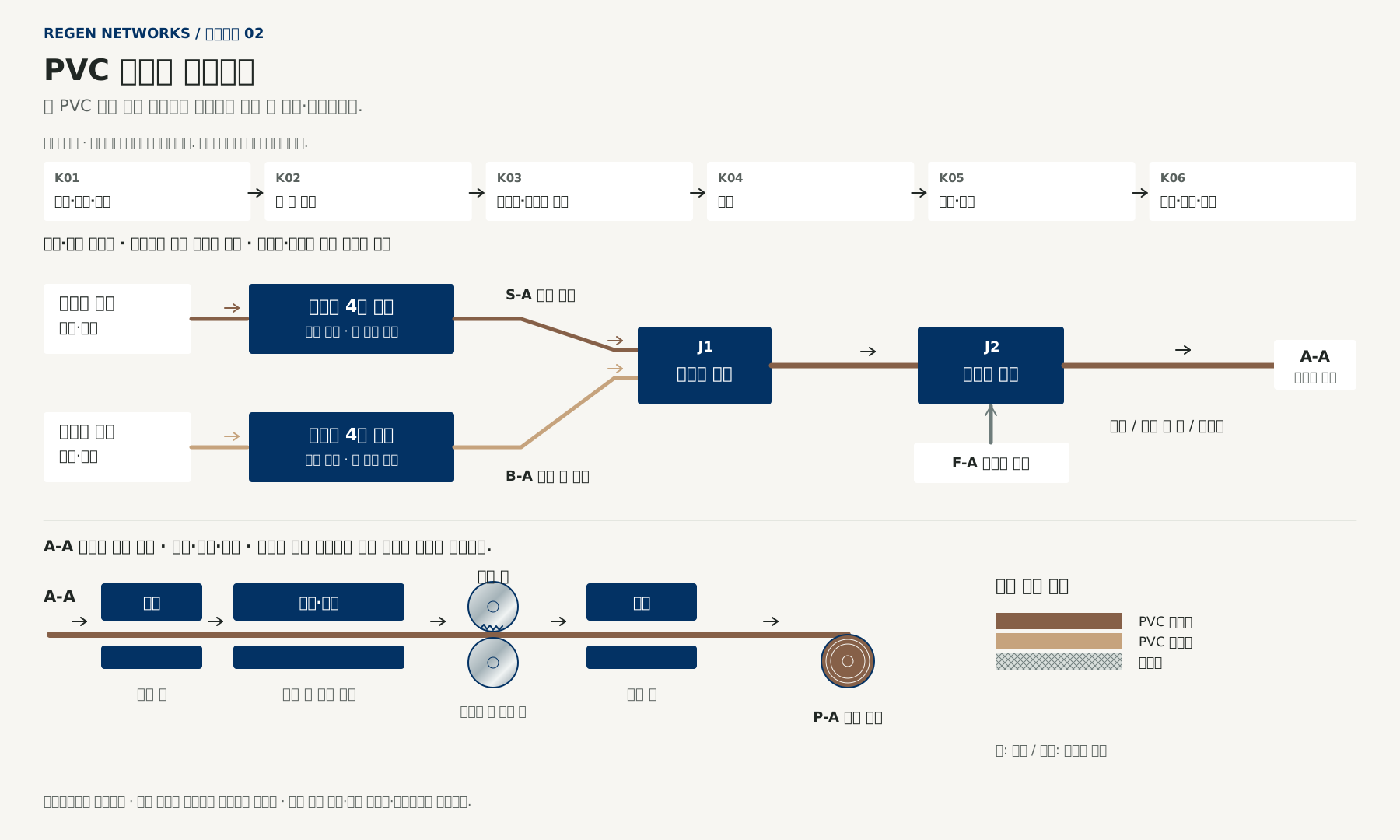
Skin and foam sheets are made separately
In this diagram the skin and foam PVC each pass through four rolls, then lamination happens twice: first the two resin layers are combined, then the backing fabric is bonded.
An AI explanatory diagram reconstructed from published manufacturing material. It is not a photograph of an actual plant, a reproduction of a REGEN line, an engineering drawing or a factory work standard.
Detail: the route of each material
| Route | Start | Link | End |
|---|---|---|---|
| S-A | Skin calender exit | Resin lamination J1 | Skin in P-A |
| B-A | Foam-layer calender exit | J1 → backing lamination J2 | Foam layer in P-A |
| F-A | Backing fabric feed roll | J2 | Backing in P-A |
| P-A | J2 composite | Cool → foam → emboss → cool | Product winder |
Terms used in this process
- Calender / calendering
- A forming process that turns resin into a continuous sheet between rolls.
- Pre-foam layer
- The resin layer that will expand in the foaming zone.
- Embossing
- A process that presses a texture into the surface with a roll.
Sources
- CN106400522A · PVC发泡人造革及其制备方法
说明书 发明内容 steps (1)–(6); claims 5–6
- Comerio Ercole · Plastic
Calendering; production equipment
Written with reference to the sources above. The specification and performance of the material you buy must be confirmed from its own datasheet and test reports.
Enquire with this guide
Tell us the product or the change you have in mind. The title of the guide you are reading is added to your enquiry.
Prepare your enquiry