


In dry-process PU transfer, the PU skin is built first on a paper that will later be peeled away — the release paper. Adhesive goes onto the skin, the backing fabric is bonded on, and the skin ends up transferred to the fabric.
The route described here is semi-dry lamination: the adhesive is partly dried before the fabric is bonded. The composite is wound up with the release paper still in it, cured if needed, and the product and paper are separated in a separate peeling step. Solvent-based PU is used, so drying is part of the line.
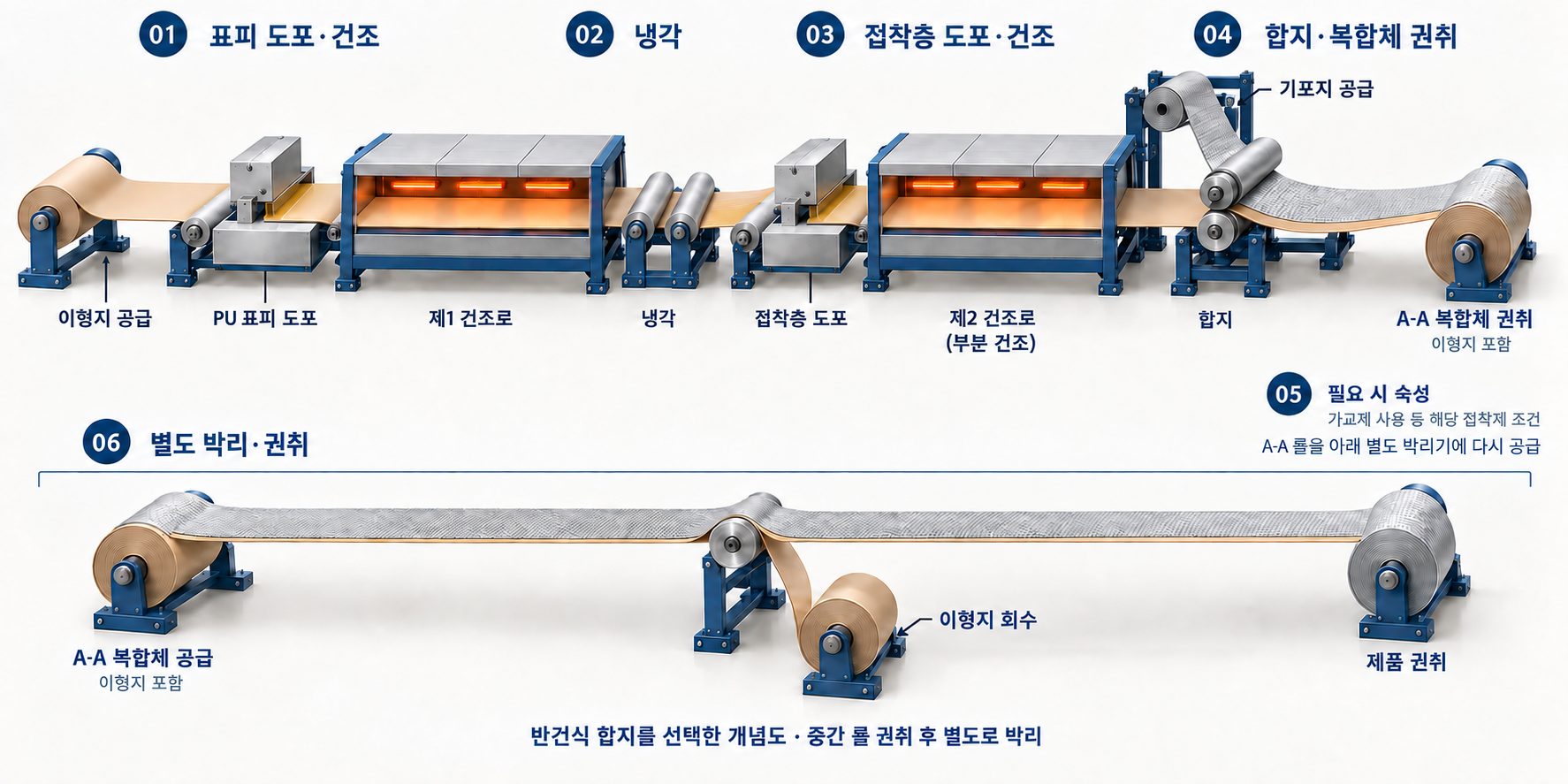
The numbers in the diagram show process order, not real equipment boundaries, distances or dimensions. Roll contact and support structures are simplified or omitted. For the exact material flow, read the route diagram and the step-by-step notes together.
From forming the skin to a separate peeling step
- Form the skin on the release paper
The skin PU solution is coated onto the release paper and dried into a film.
- Cool the skin
The dried skin is cooled while still on the release paper.
- Apply adhesive and dry it partway
Adhesive is coated over the skin. In the semi-dry route chosen here, the adhesive is dried partway before the fabric goes on.
- Bond the backing and wind the composite
The backing is bonded to the adhesive layer and the composite, release paper included, is wound up. Through the coating and lamination zones the stack reads, from the top, release paper, PU skin, adhesive, backing.
- Cure if the system requires it
With a crosslinker, curing follows the conditions set by the raw-material supplier. Further bonding and crosslinking happen during curing. The diagram gives no temperature or time to work to.
- Peel the paper and wind it separately
The composite is unwound and fed to a separate peeling machine — in the diagram, in the same layer orientation as at lamination. The paper is peeled off, and the recovered paper and the dry PU roll up onto separate winders.
How far the adhesive is dried decides the lamination route
- Bonding the fabric straight after the adhesive goes on is wet lamination; partly dried is semi-dry; almost fully dried is dry. This classification is not the same as coagulation in a water bath, which is what wet-process PU does.
- Other routes coat the fabric directly, or transfer water-based PU. The order of lamination, drying, curing and peeling follows the resin and the equipment.
What dry means here, and when the paper comes off
A process called dry is not automatically solvent-free. The route described here uses solvent-based PU, coated and then dried.
Before peeling, paper and product are wound together on composite roll A-A. After the separate peeling step, the recovered paper and the product wind onto different rollers.
Material flow and process order
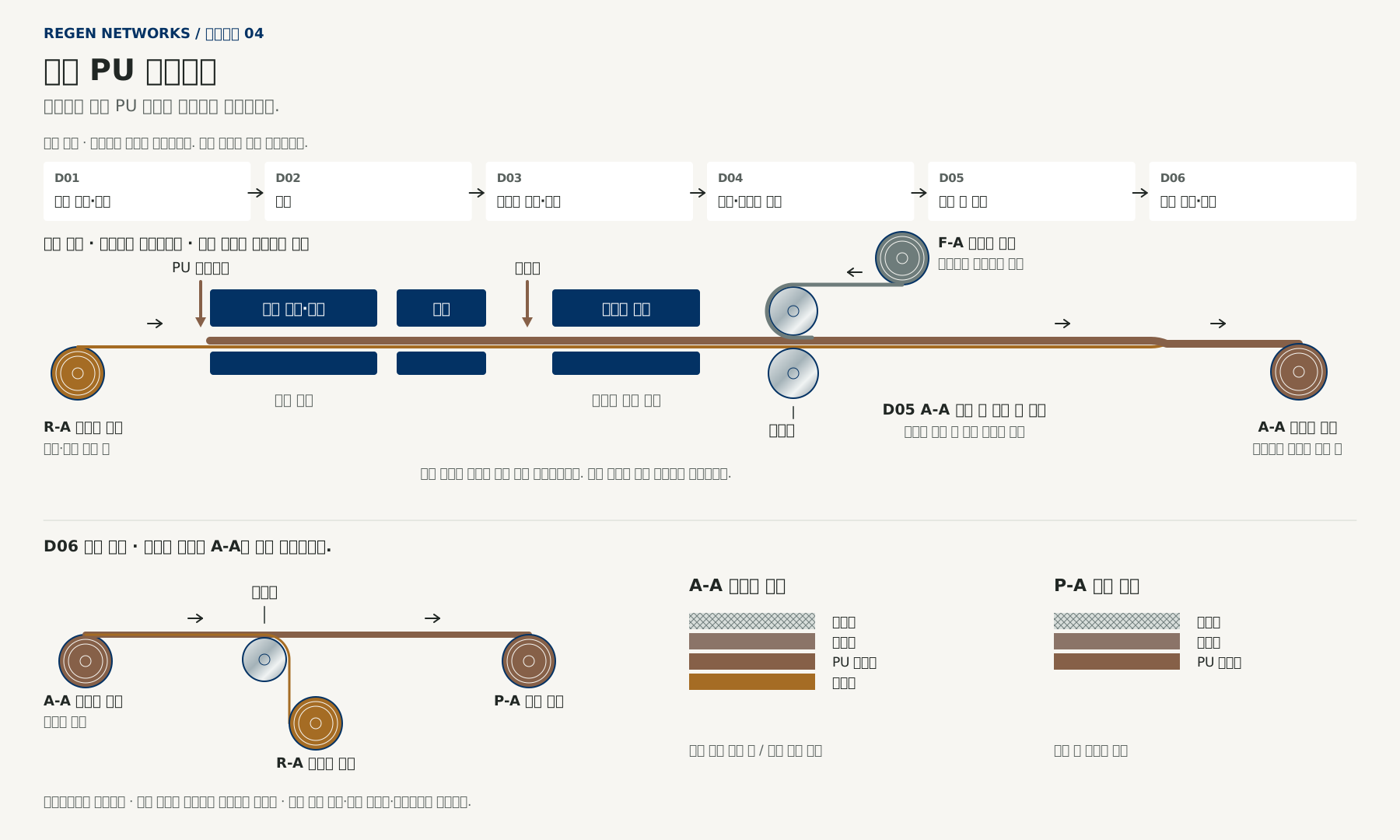
Semi-dry lamination, then peeling in a separate step
A solvent-based PU skin is built on the release paper, the adhesive is partly dried, and the backing is laminated. The composite is wound with the paper in it, then peeled in a separate step.
An AI explanatory diagram reconstructed from published manufacturing material. It is not a photograph of an actual plant, a reproduction of a REGEN line, an engineering drawing or a factory work standard.
Detail: how the paper, the composite and the product travel
| Route | Start | Link | End |
|---|---|---|---|
| R-A | Release paper feed roll | Coating → lamination → wind on A-A → unwind A-A → peeling | Release paper take-up |
| F-A | Backing fabric feed roll | Lamination → wind on A-A → unwind A-A | Stays in P-A |
| A-A | Wind the composite with the paper | Cure and move if required | Feed roll of the peeling machine |
| P-A | Peel point, separate line | Separated from the paper | Product winder |
Transfer, lamination and curing
- Transfer coating
- A method that builds the coating on a carrier and moves it onto the base material.
- Semi-dry lamination
- The adhesive is dried partway before the fabric is bonded.
- Curing
- The further bonding and crosslinking the adhesive system needs after lamination.
Sources
- Sanyo Chemical · Dry-Process Leather and Fabric Coating
p.3 Direct coating; p.4 Transfer coating, Fig.2
- LINTEC · Casting Paper R-series
Use of Casting Paper in synthetic leather production; Product grade
- Ocean Plastics · PU Knowledge
The Dry Process; Wet Process and PU Coagulation; Water-Based PU Leather
Written with reference to the sources above. The specification and performance of the material you buy must be confirmed from its own datasheet and test reports.
Enquire with this guide
Tell us the product or the change you have in mind. The title of the guide you are reading is added to your enquiry.
Prepare your enquiry