


The silicone leather described here bonds a silicone layer to fabric with an adhesive layer. This guide follows the route that makes the top coat — the outermost coating of the finished product — first.
On a carrier that supports the coating and is later removed, the top coat and then the silicone skin are formed and cured in turn. The adhesive layer and the backing fabric go on top of that. When the carrier is removed, the top coat made first is what shows as the surface.
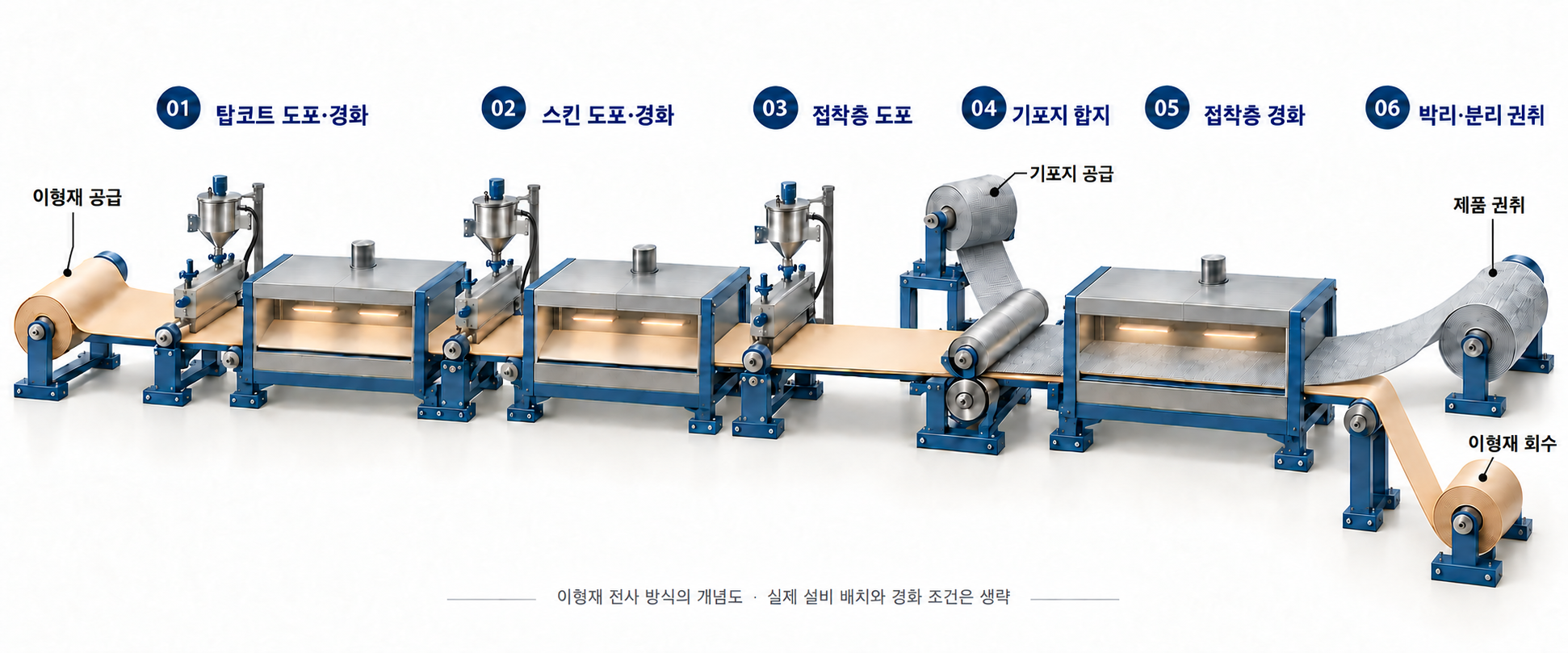
The numbers in the diagram show process order, not real equipment boundaries, distances or dimensions. Roll contact and support structures are simplified or omitted. For the exact material flow, read the route diagram and the step-by-step notes together.
From forming the top coat to releasing the carrier
- Apply and cure the top coat
The top coat — the final surface — is applied to the carrier, then cured into an elastomer.
- Apply and cure the skin
The silicone skin is coated over the cured top coat and cured again.
- Apply the adhesive layer
The silicone adhesive is coated over the cured skin.
- Bond the backing
The fabric is bonded while the adhesive is uncured or still curing.
- Cure the adhesive
The adhesive between skin and backing is cured. This curing is not the coagulation that wet-process PU undergoes in a water bath.
- Remove the carrier
The carrier is peeled at the point the process needs. The winders in the diagram are drawn conceptually, to show a continuous web.
From the top the layers read backing, adhesive, skin, top coat, carrier. The face of the top coat that lay against the carrier is the final surface; in the diagram it faces down immediately after peeling.
There is also a route that applies the top coat later
Dow also describes a later-coat route: skin, adhesive and fabric are made first, the carrier is removed, and the top coat goes on afterwards. The earlier-coat route in this guide builds the top coat on the carrier first.
Post-curing and adding further layers are optional. This process description does not include a foam layer or roll embossing.
Colour in the diagram does not tell you what a layer is
The colours in the cross-section are only there to separate the layers. A light-coloured skin does not mean it is a foam layer.
This diagram shows one transfer route from a published patent. For another silicone leather, the documents for that process decide where and in what order the top coat is made, and whether post-curing is used.
Material flow and process order
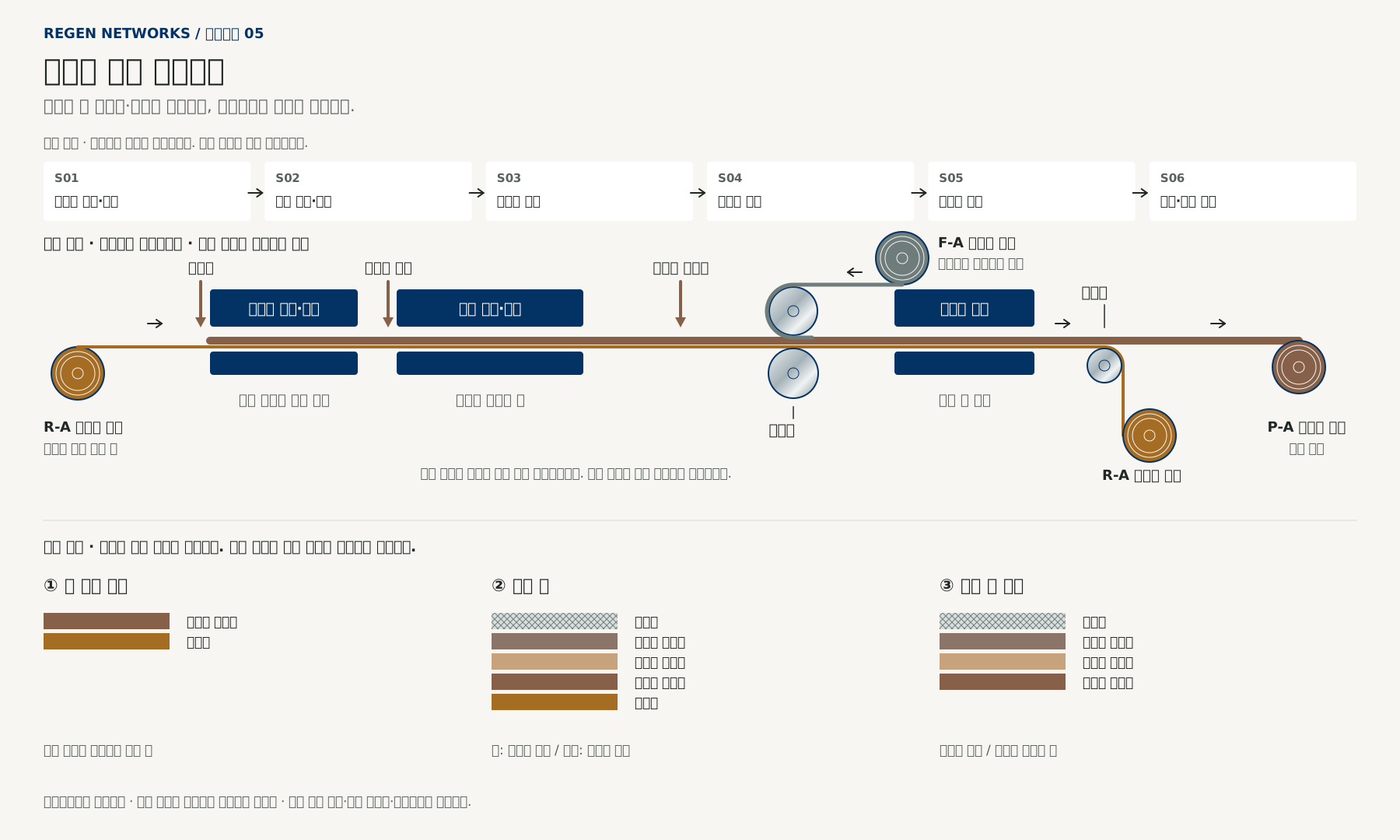
An addition-cure transfer route that builds the top coat first
Of the transfer routes that cure silicone by addition reaction, this diagram shows the one that makes the top coat first, following the layer-by-layer curing, lamination and release order of Dow patent [0090].
An AI explanatory diagram reconstructed from published manufacturing material. It is not a photograph of an actual plant, a reproduction of a REGEN line, an engineering drawing or a factory work standard.
Detail: how the carrier, the backing and the product travel
| Route | Start | Link | End |
|---|---|---|---|
| R-A | Carrier feed roll | Top coat → skin → adhesive → lamination → curing → peeling | Carrier take-up roll |
| F-A | Backing fabric feed roll | Lamination onto the uncured adhesive | Stays in P-A |
| P-A | Lamination and adhesive curing | Carrier peeling | Product winder |
Terms for the layers and curing
- Curing
- The reaction through which the silicone composition becomes an elastomer.
- Skin / top coat
- The skin is the silicone layer covering the base; the top coat is the coating on the final surface side.
- Carrier
- The material that supports the coating while it cures and is separated later.
Sources
- Dow · EP4271762B1, Coating composition and its uses
p.3 [0004]; pp.13–14 [0084]–[0093]; Figs.1–4
Written with reference to the sources above. The specification and performance of the material you buy must be confirmed from its own datasheet and test reports.
Enquire with this guide
Tell us the product or the change you have in mind. The title of the guide you are reading is added to your enquiry.
Prepare your enquiry